Showing posts sorted by relevance for query emd. Sort by date Show all posts

Sunday, January 29, 2012

EMD CEO's talk fails to mention London

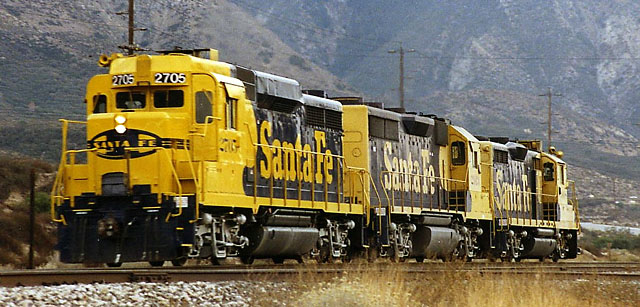
"Money-losing" EMD expanded operations in China. Progress Rail CEO Billy Ainsworth shown.

Recently, I saw this tweet on Twitter:

Here's a link to The London Free Press column.


It's a nice thought. Larry Cornies, and others like him, should hold onto such nice thoughts, but they don't have to hold on too tightly. Those thoughts, and others like them, aren't going anywhere soon.

Maybe my expectations in situations like the EMD lockout have been soured by own experience working for a big, anti-union business – Quebecor – but I don't believe the Caterpillar representatives want to sit down with the London workers.

The Cornies tweet was followed by one by late2game pointing out that although Caterpillar is well into the black as a corporation, its EMD subsidiary is a drain on the big Cat. Late2game linked to a source reporting EMD lost $16 million. Cornies replied to late2game: "Thanks; that's detail I was looking for before deadline Thursday, but couldn't find. Confirms my suspicions."

In a lockout situation, I have a hard time confirming anything in my own mind. I'm very distrustful of everyone involved. I'm especially distrustful of all the facts surrounding the crisis. The bargaining is no longer being done at the table but on the street, in the media.

As a long time investor, I'm well aware that money losing companies can be damn fine investments. I'm not saying the books are cooked, they aren't, but the bottom line is not the whole story. If a company is investing a lot of money to grow future profits, the present may suffer. This does not mean the company is in trouble, especially if it is a subsidiary of a much larger company – one with very deep pockets, like Caterpillar.

John Hamilton, Electro-Motive Diesel CEO, has made great strides in growing the once faltering operation. I don't believe that EMD, once the little engine that could, is now the little engine that couldn't (turn a profit).

In London, we like to think of EMD as having its headquarters and some production facilities in La Grange, Illinois and its assembly plant in London, Ontario – and that's it. Well, a few years ago that was sort of true, but not today. (The production is actually in McCook, Illinois, just outside of La Grange.)

Today's EMD is not the company it was when it opened its London, Ontario, plant. EMD today:

  • has opened a 740,000 sq. ft. assembly plant in Muncie, Indiana – that's far larger than the older, London, Ontario EMD facility.
  • is expanding and modernizing an existing manufacturing plant in Sete Lagoas, Minas Gerais, Brazil to assemble and manufacture Electro-Motive Diesel-branded locomotives
  • is producing EMD labelled locomotives at the Ciudad Sahagún Bombardier plant in Mexico.
  • is hoping to produce locomotives in the near future in India.
  • has opened a facility in San Luis Potosi, Mexico for traction motor maintenance and locomotive overhaul work.
  • is opening multiple warehouse operations in northeastern China supporting a growing fleet of 6000-horsepower EMD. The complete assembly of locomotives for the Chinese market is envisioned.
  • and the list goes on

According to the Wall Street Journal, EMD recorded $1.8 billion in global sales in 2008-09, making it one of the largest builders of diesel-electric locomotives in the world. Is EMD losing money? If it is, the management of EMD is incompetent and I don't think EMD management is incompetent. I doubt EMD is in financial trouble. The red $16 million dollar bottom-line number is nothing to be concerned about.

When EMD president and CEO John S. Hamilton appeared before the House Transportation and Infrastructure Subcommittee on Railroads, Pipelines, and Hazardous Materials Hearing, on April 20, 2010, he bragged a great deal but he never got around to mentioning London.

"EMD was a floundering subsidiary of GM, with a very questionable future. Today, EMD has witnessed record revenues, earnings, and investments. Exports have doubled. Factory productivity is up 20 percent," he boasted.

He continued, "Over the last two years, our exports to India and China were over 50 times greater than our imports from those two countries. Few, if any, large heavy manufacturing companies can say that. We estimate that in our five years as an independent company, we have single-handedly improved the United States trade balance by $200M."

"We employ 1,600 workers in the U.S.," he said.

Concerning high speed rail, he said, if given the chance EMD "would make most all of the critical technologies [in McCook, Illinois]. We have the equipment. We have 1,600 American workers ready to do this work and we would recall workers currently on lay-off to meet the additional workload. In accordance with Buy America, we announced last week a search for a facility in which to perform final assembly. [This would be the Muncie plant that is now in limited operation.]

EMD is a company on the move. And everything indicates that their next big move will be to move out of London. [Shortly after writing this, Progress Rail and EMD announced the closure of the London plant. EMD moved out of London.]

Buy America Act

The Buy America Act was a provision of the Surface Transportation Assistance Act of 1982 and is now codified by Section 5323(j) of Title 49 of the United States Code. Buy America provisions are applied to transit-related procurements valued over US$100,000, for which funding includes grants administered by the Federal Transit Authority (FTA) or Federal Highway Administration (FHWA). Buy America provisions are a condition of U.S. federal government grants to state, municipal or other organizations including transit authorities. Buy America provisions, such as requirements for 100% U.S. content for iron/steel and manufactured products, put Canadian goods and services at a serious disadvantage when they form all or part of a bid by any supplier, whether U.S. or Canadian. Similar conditions prevail for airport projects that receive funds from the Federal Aviation Administration as authorized by the Airport and Airways Facilities Improvement Act. Such projects require that all steel and manufactured products have 60% U.S. content and that final assembly occur in the United States.

Note: Under NAFTA, the U.S. requires that Canadian goods and suppliers be exempt from these requirements if certain demands are met. That said, applying the exemptions can be messy and convoluted. Don't think for a minute that NAFTA provides simple protection for producers such as Electro Motive Diesel in London.

Thursday, January 5, 2012

Are London EMD workers facing a Hobson's choice?

Are the locked out EMD workers facing a Hobson's choice?

The London Free Press reporter Scott Taylor reported in the Thursday paper that the lock out at the Electro-Motive plant in London is a local conflict with global causes. The reporter quotes Anil Verma of the University of Toronto's Rotman School of Management to back up this position. "Workers in China can make locomotives as well as they can here, so they're now facing the competition," the university expert told the paper.

I was puzzled. The threat facing the London jobs comes from Muncie, Indiana. The last time I checked Muncie was in the United States and not China. In the expert's defence, my guess is he was given a cold call by the reporter and the professor gave the caller his generic response.

Still, the paper reported Professor Verma "Thinks a deal can be reached . . . " Why? How? I was puzzled. I have been working on a piece of the Digital Journal, so I decided to give the professor a call. It turns out that he is in Chicago at a conference and unavailable until next week for an interview. But, he graciously sent a brief response to my e-mail.

Anil Verma wrote:

"You are probably right in terms of the immediate threat. I referred to China as competition, in general, for a wide range of manufacturing jobs. I do not know enough about EMD's specific competitive position in the industry in terms of costs, productivity, quality, etc."

I was right. He was called cold, given little background to the story, and being a gracious gentleman, he gave the reporter his generic China response.

Allow me to examine the the threat of closure facing the London EMD plant. A lot of stuff going into locomotives assembled in London originates in McCook, Illinois, located just outside La Grange where the EMD head office is located. The parts are shipped about 685 km from McCook to London, crossing the Canada/US border at one point. It is about an eight hour trip by truck — an expensive eight hour, international trip at today's exchange rate.

Progress Rail Manufacturing Corporation, a totally owned subsidiary of Progress Rail Services, now has a plant in Muncie, Indiana, less than 400 km and four and a half hours, from McCook. The Muncie plant, originally built by Westinghouse, then purchased by Asea Brown Bovery (ABB), has been rebuilt as a locomotive assembly plant at a cost of $50 million.

The 740,000 sq. ft. plant is massive with a main floor 1,960-feet in length, a 99-foot ceiling in the former transformer assembly area and locomotive-sized entry doors with railway tracks running through the building. It took only a year after its purchase for Progress Rail to hold the plant's opening ceremony.

Like London, a lot of what goes into the Muncie produced locomotives originates in La Grange, Illinois.  Unlike London, the Muncie workers are non-union, always a plus in the Caterpillar/Progress Rail playbook. Recently, Progress Rail posted a job opening for an HR Manager at its new Indiana assembly plant, they stipulated that the candidate should have "experience with providing union-free culture and union avoidance." The job is now filled but the union avoidance line is still shown on the online posting as I write this.

Welding jobs at the new facility are reportedly paying from $12-$14 an hour. Do the math. That's $24,960 annually to start for a 40-hour work week. This places these workers squarely in the ranks of the working  poor. There are a lot of working poor in Indiana according to The Working Poor Families Project.

Glassdoor, a site for employment information in the States, carries this comment:

"For a company [Progress Rail Services] that says that safety is number 1, they don't practice that. Employees are treated like dirt; both in pay and the softer sides unless you are a YES man. Unfair and inconsistent discipline and promotions, confidentiality is breached on a daily basis, safe work practices are bypassed in the interest of more and faster production, very little integrity in local management." 

Why should the London workers be concerned about China when they've got Indiana? Companies like Progress Rail and its parent, Caterpillar, don't have to go to the third world, they bring the third world to North America. David Olive, of The Toronto Star, looked at this development in an article: America, the world's sweatshop.

Welders in London make a living wage of about $35 an hour. It's good money and a lot of it stays in the community. It is good for the worker and good for the community. And in return, the company gets good work  — excellent work in fact.

This doesn't mean that Progress Rail, and EMD before it, is not taking advantage of what the third world has to offer. At least as early as 1998 EMD was working closely with Bombardier in Mexico. Recently, the first order of 32 EMD diesel-electric locomotives was assembled under contract at the Ciudad Sahagún Bombardier plant, Mexico. Progress Rail (South America) also has a new facility in Sete Lagoas, Minas Gerais, Brazil.

Before Progress Rail and its parent Caterpillar Inc. came on the scene and purchased the entire EMD operation in 2010, most (but not all) EMD locomotives were assembled in London, Ontario in one plant approximately two thirds the size of the refurbished facility opened in Muncie. Some limited EMD assembly and painting was done by SuperSteel Schenectady, Inc. (SSSI), Glenville, N.Y., and, as mentioned earlier, by Bombardier in Mexico. Sometimes, after assembly at SSSI, some locomotives were sent to Alstom in Hornell, N.Y., for finishing and final paint. I have heard reports, see comments after this story, that some work might have also been done in St. Catharines.

With so many plants available for locomotive assembly, why was an entirely new plant created in Muncie?  — a plant with a much larger floor area than the one in London and with a proposed staff, when fully operational, approximately the same size as London's? Well, for one thing, the SSSI factory which produced everything from streetcar shells to locomotives was shut down in 2008. The SSSI closure underlined the need for a U.S. assembly plant to meet the made in America demands. I believe the new Muncie plant was designed right from the start to replace the London operation.

I fear that the EMD/Progress Rail/Caterpillar hierarchy of companies extended the contract in London in order to buy time to get the plant in Muncie operational. Remember, if problems should arise at Muncie, Progress Rail does have options when it comes to assembly and painting of new locomotives.

If the London workers don't accept the pay cut and the present lock out begins to hurt the company's bottom line, maybe the company will fold their hand and shelve demands that would not look out of plane in a book by Charles Dickens. But, I doubt it. What ever happens,  when Muncie is up and running, backed by a plant in Mexico, I believe the London facility will be shuttered.

If  the workers take the pay cut, they will return to work but their lives will be in tatters. Mortgage payments, car payments, monthly food bills, possibly tuition for children in university, all will take massive chunks out of their vastly shrunken family budgets. I predict marriages will fail under the stress. After earning a decent wage for years, it will be economic hell for the EMD workers.

I see the London EMD workers facing a Hobson's choice. No matter what decision the locked out workers make, in the end they will find themselves out of a job.

Locomotives: They're big, expensive and U.S. workers build 'em for $12.00 / hr. and up.

Addendum: This report reflects a correction sent anonymously. The correction can be seen in the comment section.

Tuesday, February 7, 2012

MP Susan Truppe is being silly

MP Susan Truppe refused to stand with the locked out London workers.

Saw a tweet calling attention to a survey posted by MP Susan Truppe. The tweet called the survey silly. Truppe defended her survey tweeting back, "I don't see how its silly to ask if constituents feel its important or not."

Once attracted to her site, I noticed the MP had posted a statement on the labour dispute at Electro-Motive Diesel.Talk about silly. Why quibble over a survey when you've got a messed up statement clearly showing that the MP doesn't know much about the EMD operation in London.

She tells us, "It is important to note that, since the 1930’s, the EMD plant has been under American ownership." Huh? EMD is an American company and always has been. It was incorporated in Cleveland, Ohio in 1922 and bought by General Motors Corporation in late 1930. There was no facility in London until 1950 when GM opened the London EMD branch plant.

The EMD story gets interesting, with a strong feeling of deja vue, when we get to 1993. Read part of the story carried by the Chicago Tribune at the time.


"World's Largest Locomotive Builders" reads the sign outside the United Auto Workers Local 719 in southwest suburban La Grange. For more than 50 years, workers at the massive General Motors Corp. Electro-Motive Division plant down the street could claim the title without controversy.

Then last month the last two blue, orange and black diesel locomotives rolled out of the plant and into service for Metra, the Chicago area commuter rail system. The sign became a depressing reminder of past glories.

Only a dozen years ago, the sprawling, 3.6-million-square-foot factory was filled with the clang of metal presses, the hiss of welders, the cacophony of 13,000 skilled workers, and celebratory bell-ringing as they finished each of up to six locomotives a day. These 180-ton, 3,800-horsepower machines selling for more than $1 million apiece were not only industrial behemoths but also computerized, precision-finished, high-tech products.

Now fewer than 3,000 people are on the rolls, including 1,600 active production workers. The main bay where locomotives were assembled, a vast work space covering several football fields and rising nearly six stories, stands empty and silent like an abandoned cathedral.

The remaining workers still build diesel engines and components for locomotives that Electro-Motive now assembles at its Canadian factory. But management is busy shrinking the plant's size and work force and sending work to outside contractors.

It is also shrinking the hopes of union leaders who gambled on working with General Motors to save the plant."

The work that was shifted to London about two decades ago has now been reclaimed.

MP Susan Truppe wrote, "I remain hopeful that both the Canadian Auto Workers (CAW) and EMD can return to the bargaining table and find an amicable solution as soon as possible." This isn't just silly, it's insulting.

London has been losing its grip on the production of EMD locomotives for years. As early as 2000 at least, in order to meet the delivery schedule for 1,000 SD70Ms for Union Pacific, EMD spread workload among:
  • GMLG in London, Ontario, Canada (assembly and paint)
  • Bombardier-Concarril, Sahagun, Mexico (assembly and paint)
  • SuperSteel Schenectady, Inc. (SSSI), Glenville, N.Y. (assembly and paint)
  • Alstom at Hornell, N.Y. (final finishing and final paint, after assembly by SSI)

Long before Caterpillar entered the picture, EMD was one tough employer. Despite union efforts to prove the La Grange workers could compete, the workforce continued to shrink even after locomotive assembly went to London. The union worked hard for a year and a half to meet a company production goal for electrical coils, after the goals were met, the company shipped the production out anyway.

The move to open a new assembly plant in the States was underway while EMD was still under the control of the private equity groups. When Muncie opened last October, the writing was on the wall. Muncie was closer to suppliers, 50 percent larger and somewhat more modern than London. Assembly in Indiana skirts currency risk and the new workers are non-union. They will work for working-poor wages.

MP Truppe may have believed CAT would return to the bargaining table, but maybe Truppe also believes in Santa Claus and the Tooth Fairy. The last two beliefs are not as silly as the first.

Wednesday, June 20, 2012

Please, allow me to answer Joe Fontana's EMD questions

I checked out Mayor Joe Fontana's website today. I discovered a post titled: Statement regarding EMD – February 3, 2012.


Screen grab from Mayor Joe Fontana's website.

In his post Mayor Fontana tells us:

  • I cannot understand why Caterpillar has chosen to announce the permanent closure of the EDM facility . . .
  • I cannot understand why Caterpillar would not return to the table and negotiate . . .
  • I cannot understand why Caterpillar has not stepped up and acted in good faith and demonstrated respect for its employees.

Please don't take this wrong, Mr. Fontana, but the answers are as close as the Internet. Since you and your staff seem to have a problem using Google, let me be so bold as to supply you with the answers and some links.

When Caterpillar bought EMD the closure of the London assembly plant was already well into the planning stage.

Electro-Motive Diesel president and chief executive officer John S. Hamilton appeared before the House Transportation and Infrastructure Subcommittee on Railroads, Pipelines, and Hazardous Materials Hearing, on April 20, 2010. At that time, he bragged a great deal but he never got around to mentioning London. [Note: Caterpillar and Progress Rail signed the agreement to purchase EMD on June 1, 2010. This is months after CEO Hamilton made his appearance.]

Concerning high speed rail, Hamilton said if given the chance EMD "would make most all of the critical technologies [in La Grange, Indiana]. We have the equipment. We have 1,600 American workers ready to do this work and we would recall workers currently on lay-off to meet the additional workload. In accordance with Buy America, we announced last week a search for a facility in which to perform final assembly. [This would be the Muncie plant that is now in limited operation.]

With these words the death knell was sounded for the London operation.


Caterpillar did not return to the table because there was nothing to negotiate. Keeping the London plant open while the U.S. operation was being brought up to speed was appealing ---  but only if it could be done at a bargain basement price.

When the London workers didn't go along with the hefty cuts proposed by Caterpillar, the plant closed. No one should feign surprise or claim to not understand what just happened and why. It wasn't hard to fathom. I blogged on the eventual shut-down almost a full month before the closure was officially announced.

If you'd like to have links to my relevant EMD posts, here are a couple:

You wonder why Caterpillar acted as it did. You ask, why didn't it "demonstrate respect for its employees?"

Mayor Fonatana claims ignorance.
Companies like Progress Rail and its parent, Caterpillar, are bringing third world employment to North America. David Olive, of The Toronto Star, looked at this development in an article: America, the world's sweatshop. Why would you expect London workers to be treated any differently than their American counterparts?

As I suggested in early January, the locked out workers in London were given a Hobson's choice. No matter what decision they made, in the end they were going to find themselves out of jobs.

I believe it is important that you understand what went down at EMD. Your ability to turn around the economy in London may well depend on it. I do hope I have been able to help and that you no longer are puzzled by the EMD closure.

Friday, February 24, 2012

London EMD workers never had a chance; jobs were gone


The London Electro-Motive Diesel workers, locked out by Caterpillar Inc., have ratified a severance deal. The 465 unionized workers are receiving three weeks pay for every year at the plant, plus $1500. And Caterpillar is kicking in $350,000 for a transitional centre to help workers find employment.

In print, the local paper is continuing to spread the myth that a profitable company, Caterpillar, is shutting down an efficient plant simply because American workers will work for less. If only this were true, but it's not.

It is complex world and it should come as no surprise the decision to close the London plant, a plant with a history going back to the middle of the last century, was not made just to save a few dollars. Although, I am sure that was a bonus appreciated by CAT.

The London locomotive plant is a remnant of the steadily shrinking branch plant economy that once powered Ontario. Before there was Mexico, there was Canada, and for Americans Canada was Ontario.

I'm old enough to recall when the Canadian dollar was worth more than the American dollar --- about six percent more at one point. The high value of the Canadian dollar was said to be killing Canadian competitiveness. In the early '60s I can recall hearing that the Canadian government was undermining the value of the Canadian dollar.

In June 1961 the Canadian and American dollars were about at par. By May of the following year, the Canadian dollar ceased to float and was pegged at 92.5 American cents. It stayed there until mid-1970. Canadians called the depreciated buck the Diefendollar. It may have inflated the cost of imported products bought by Canadians but it encouraged manufacturing in Ontario.

Currency Risk: a reason for business to relocate outside of Canada.

It is a different world today. This should come as no surprise. It is now 2012. Fifty years have past. A lot happens in fifty years and for Canada, for Ontario, what has happened is not good.

The cheap Canadian dollar is a feature of the past. The post war boom is now but a distant echo. The United States is pulling in its horns and its branch plants. Think: Ford (St. Thomas/London), Sterling (St. Thomas), Navistar (Chatham), Westinghouse (London) and now EMD. And this is just a short portion of a very long list.

There are advantages to pulling manufacturing out of Canada and sadly it is not just American businesses that are being closed and pulled out of the country. EMD was an American branch plant. It always was. Its closure was no big surprise. This is a story that has been repeated time and time again right across the province.

It was not the refusal of the workers to accept a pay cut of approximately 50 percent that chased EMD from Canada. The London Free Press is reporting that CAW president Ken Lewenza said:

"A union member found a document indicating Progress Rail, a subsidiary of heavy equipment giant Caterpillar Inc. and parent company of Electro-Motive, always intended to close the plant, and had no intention of reaching a negotiated settlement.

"The letter on the Progress Rail website from company president Billy Ainsworth advised employees the London plant was closing and was dated May 23, 2011, more than eight months before the closing was announced.

"Lewenza said the company didn't refute the date or authenticity of the letter when confronted at the bargaining table."

While the closing of a branch plant is not surprising, what does come as a surprise is the closing of all the Canadian plants, like the Bick's pickle plant. Bick's was a Canadian operation started during the Second World War in Toronto. It was recently bought and closed by Smuckers out of the States, moving production to the States.

Back in the '70s, my first range was a McClary made in London. McClary closed its London plant and moved to Hamilton, merged with other appliance makers under the Camco banner. But Camco was bought out by Mabe, possibly the largest Mexican appliance maker. There is no production, that I know of, left in Canada.

The Canadian middle class is in trouble. Serious trouble. When I worked at the local paper, The London Free Press, many of the reporters and editors worried that one day Quebecor would decide to play hardball with them, with their union. They were concerned about their wages, their benefits, their retirements. Quebecor, like CAT, does not recoil from locking out its workers. Quebecor, like CAT, hates unions and has a reputation for union busting.

If the newspaper was searching for "an example of unconscionable greed that undermines every middle-class worker" the newspaper shouldn't have looked to EMD. It didn't have to look past its front doors.
_____________________________________________________________________

One note: Quebecor in London, like CAT, has made leaving easy for its workers. When  the CAT worker said that the severance deal was "Better than a kick in the teeth," I could not agree more. I took a severance package and left the paper after more than three decades at the place.

I took a hit on my pension and my CPP; Both suffered cuts of about 24 percent because I had to start drawing years early. Still, I cannot knock the deal. I thank Quebecor, my union and my co-workers who toiled for me as my union reps hammering out my severance package. Thank you Shelley, et al.

I pray the EMD workers nearing retirement do as well as I have done. I wish them all, "Good Luck!"

Monday, May 28, 2012

ReThink London suggestions

ReThink London has put the spotlight on London's Prosperity Plan (LPP) and the upcoming June 9th meeting.

From May 9th until June 1st, Londoners are being invited to submit their ideas on ways we can work together to achieve the goal of strengthening our local economy and creating jobs. Click the LPP link, learn how the Investment & Economic Prosperity Committee (IEPC) is developing a 10-year plan to move London's economy forward faster and ensure long term prosperity for the community and make your comments soon. June 1st is fast approaching.
____________________________________________________________________________

My suggestions, not in order of importance:

From the U.S. DOT Buy America webpage.
1. Work with the provincial and federal governments to create a better environment for employers in the province. We need an environment that will attract new businesses to our city while encouraging present employers to stay.

Take the recent exit of Electro-Motive Diesel from London. The "Buy American" movement teamed with the rising value of the Canadian dollar rang the death nell for this once solid London employer. The fact that EMD had recently been purchased by an anti-labour, multi-national, Caterpillar Inc., with a history of union-busting just further complicated an already badly snarled situation.

London's mayor was mainly bluster.
Take a look at the U.S. Federal Railroad Administration website. There were walls going up around the London facility, high walls composed of U.S. regulations which were making the plant difficult to operate profitably.

2. Stop the empty rhetoric. Again looking at EMD. It was a dire situation demanding fast action and great wisdom. Preventing the closure of the locomotive assembler and the loss of as many as 700 local jobs called for a response steeped in a full understanding of the complexities of the fast deteriorating situation. How did London's mayor, Joe Fontana, rally to the moment? He bellowed loudly, "Get your ass down here, Prime Minister Harper!"

The PM didn't appear. No surprise. EMD moved production to the States. Again, no surprise.


Locked out workers were never going to return to EMD.
3. If ever there was a situation calling for proactivity it was EMD. There were numerous, unmistakable signs the London plant was being considered for closure. These signs were brought into sharp focus when the contract talks went into overtime with a six month extension. Yet, city hall did not twig to the looming disastrous job loss. Months before the lockout, London's mayor should have been following the advice he shouted out to the PM.

It was a story of too little, too late.

A lot of  London's water pipeline was buried and forgotten.
4. The City of London has to get its financial house in order. The present zero tax increase approach is not the answer. Cities function because of a complex infrastructure developed over decades. This infrastructure must be maintained. Creating a budget that is kept artificially low by putting maintenance on hold is, as they say, penny wise and pound foolish.

As Gina Barber wrote after the second water pipeline break in as many years:
"It also brought home the importance of well-maintained infrastructure. This is the second time in the last couple of years that there has been a break in this almost half century old system. Just under half of the system has been “twinned”, to allow water distribution to carry on unimpeded in certain areas even when a disruption occurs. The remainder is yet to be twinned, but it’s expensive and the current council has balked at introducing the rate increases that are needed to pay for the infrastructure upgrades. When staff recently recommended introducing a larger flat rate component in the water bill to cover infrastructure costs, the Civic Works Committee was split on the issue. Some, like Councillor VanMeerbergen, insisted that there had to be a better model, one that didn’t cost so much."
Businesses must be able to put their trust in the city's infrastructure. A city that puts off necessary maintenance is a city with one black mark against it.

5. Cities need developers but developers need guidance from cities. It is very clear that developers in London are not given the guidance that they need. This is not good for the city and, in the end, it is not good for the developers.

Affordable housing being constructed on Dundas St., EOA.
Nicolai Ouroussoff wrote in The New York Times, "Even the most majestic cities are pockmarked with horrors." In a city as large as New York or Toronto, there are lots of good buildings to buffer the shock. This is not so in smaller places like London. In small cities, horrible architecture reverberates loudly.

Ouroussoff says the best solution for solving the problems of architectural horrors might be the wrecking ball. I might suggest a little forethought. A little planning. Don't allow the ugly stuff to be built in the first place.

We don't have to look farther than East London for an example of bad architecture.

An EOA century plus building has panache.
The London Free Press calls the construction of 12 one-bedroom apartments above six ground floor commercial units a "rebirth" for a section of Dundas Street that has been in declined for decades.

Sadly, one doesn't have to look farther than the end of the block to see more attractive, but equally dense, architecture. While other communities around the world are demanding more from their developers, demanding beauty along with function, London is failing the grade.

What is really interesting is that the local paper has long been a champion of the ideas of Duany Plater-Zyberk & Company. The local paper has also written approvingly of the actions being taken by the small town of Birmingham, Michigan, at keeping their well respected little burg at the forefront of modern thinking on successful urbanism. Birmingham has an urban plan prepared for the community by DPZ.

Maybe London should consider borrowing some of the ideas of this famous architectural firm. Do a little googling and see what other communities are doing. For instance, Birmingham is looking at form based code.

Form-based code in action in Birmingham, MI.
6. Form-based code

A form-based code is a method of regulating development to achieve a specific urban look. Form-based codes create a predictable public realm by focusing mostly on physical form. Land use controls are secondary. Form-based codes address the relationship between building facades and the public space, the form and mass of buildings is controlled in relation to one another, and the scale and types of streets and blocks.

Click this link to form-based code. If FBC was being used in London, Ontario, it might have prevented the monstrosity going up in EOA.

Walkable. Sorta. Mostly designed for car travel.
7. As we ReThink London, let's not be too intent on belly-button gazing. Let's look outside of the city and see what stuff other folk are doing in other communities.

For instance, London has what is being touted as a new gateway to the city: Wonderland Road South.

The London Free Press writer Randy Richmond tells us: The plan is for this southwest corner of London to become a living and economic gateway to the city, a showcase of London's very best qualities.

Is Richmond really serious? I'm sure he has the plan wording correct, but is this really what is transpiring? I don't think so. This development could be much better. For all the local talk about walkability, the commercial development in the Wonderland and Southdale Road area sports few of the features one would expect if walkability was truly a goal.

Legacy Village, Columbus, Ohio
I advise the city planning folk to get in a car, share the expense, and take a drive to Columbus, Ohio to visit Legacy Village. This is one approach that might have been considered as an alternative to what is continuing to be expanded along Wonderland Road South.

Be aware, I am not suggesting London copy Legacy Village but be inspired by it. With all the residential development in the Wonderland/Southdale area, a walker-friendly shopping area that is also car and bus welcoming, would have been ideal.

Another spot that could have benefited from a little Legacy Village thinking is the shopping area on Southdale Road at Col. Talbot Rd. Sad to say, the original plan for the London intersection promised a new urbanist commercial area. It didn't happen and it leaves one wondering what plans today will not happen. Just being a good plan doesn't seem to be enough. Talk is cheap in London.

Well, that's it for today. May post more tomorrow. I've gotta be prepared for the upcoming ReThink London meeting.

Tuesday, January 20, 2015

Why Ontario greenhouse operations are expanding into Ohio.

This is the time to form partnerships with grocery stores, restaurants, and food service industries, in order to persuade key players to support American agriculture products. In our communities, we need to exercise the power of the dollar. Make a conscious decision to buy American grown products.”
-- Aaron Preston - Future Farmers of America
Saturday I read an article on the reason greenhouse operations in Essex County are leaving the Leamington/Kingsville/Lakeshore area. It is because of electricity problems; it costs too much and the grid is inadequate. The article laid the blame on the governing Ontario Liberals.

"No Juice For Veggies" the headline read in a big, bold font. "Power problems push growers elsewhere" the reader on the Web was told and the writer should know. He's from the Leamington area and has relatives working in the greenhouse industry. Yet, like so many other Free Press articles, I was left with more questions than answers.

Leaving Essex County for Ohio simply to reap the benefits of being on  the American electrical grid seems a reach. As the International Business Times reports: "The United States endures more blackouts than any other developed nation. . . . " The American grid suffers from an increasing number of blackouts because of an aging infrastructure, a lack of investment and no clear plans guiding modernization. The Ontario Liberals are not alone at mismanaging the power grid and, make no mistake, they have mismanaged the grid. There is no argument there.

It's true that the little Southern Ontario town of Leamington and the surrounding area has lost jobs to the United States. At a city Economic Development Committee meeting a year ago, Chair Louis Saad raised the issue of incentives to encourage businesses to remain in town. It seems a local business owner was considering moving his company south of the border to benefit from the lower cost of living, the more favourable tax rate and the generally less expensive business environment in the United States.

Chair Saad was told it was illegal for the Municipality to give incentives to businesses. This was not news to Saad. He has complained in the past that "(The U.S.) has a lot of tax incentives that aren’t legal in Ontario." Saad argued Southern Ontario communities must be able to offer incentives in order to attract the companies that otherwise would take the jobs to Michigan and Ohio.

Mark Balkwill, president of the Essex County Federation of Agriculture, agreed. Balkwill has been quoted as saying that a major player in the greenhouse industry was opening an operation in Ohio after the state offered to match dollar for dollar any investment in production facilities. In addition, the state promised no property taxes during the first five years of operation.

Balkwill may have been referring to Nature Fresh Farms which stated in a press release that their move into Ohio was "contingent upon acceptable levels of incentives from the State of Ohio and other government authorities as well as utility rates agreeable to Nature Fresh." The Leamington grower may have received the incentives as there are no signs that the expansion is not going through.

And there is one other reason Canadian greenhouse operations are expanding into the States: Money. The United States is where the money is. And it is not just Canadians looking to expand into the States. Greenhouse growers in the Netherlands are actively looking for opportunities in the States.

A report released by Dutch greenhouse sector points out: "It is remarkable that the total area of greenhouse production in the US only amounts to 9.100 hectares, while in the Netherlands greenhouse production takes place under 10.400 hectares, (even though) the US is 244 times larger than the Netherlands and has almost 20 times the number of consumers. . . . the US greenhouse sector has some room to grow."

Historically the U.S. has imported most of their greenhouse grown food but in the past few years the domestic production has increased significantly. Why? A small part of the reason is a growing trend to buy foods grown locally whenever possible. This puts foods from both Mexico and Canada at a disadvantage and even Florida and California when one is considering the Midwestern and Northeastern markets.

The Meijer grocery store chain likes to brag that it has purchased from local growers since opening some 80 years ago in Greenville, Michigan. Today the chain brags it sells Michigan-grown tomatoes and sweet peppers supplied by Mastronardi of Coldwater, Michigan. Mastronardi was originally a Canadian greenhouse operator.

The "Buy America" movement touches the entire American market for consumer goods and is backed by politicians on both the right and left. In 2008, Barack Obama promised rural Ohio voters he would "enforce Buy American requirements to protect specialty crops." Fruits and vegetables are counted among specialty crops.

The Obama campaign literature claimed demand for locally grown foods was growing quickly. For this reason Obama supported the immediate implementation of the Country of Origin Labeling law. COOL would enable American consumers to distinguish imported foods from those grown within the States. Obama argued consumers "deserve the right to know where their food comes from."

EMD workers locked out without a hope of being called back.
When London, Ontario, lost Electro Motive Diesel a London Free Press columnist tweeted, "Electro- motive workers should give their assent to a team of shuttle diplomats."

Maybe, I thought, but I put far more faith in the words of John Hamilton, CEO of Electro-Motive Diesel. He told a House subcommittee: "In accordance with Buy American, we announced last week a search for a facility in which to perform final assembly."

To sell locomotives in the States, in any quantity, EMD was going to have to build those engines in the States. The closing of the London assembly plant should have come as a no surprise to anyone.

The other reasons given for closing the EMD plant were real but they were not the whole story. For instance, the problems with the electrical grid in Ontario are very real and electricity in the province is among the most expensive on the continent. But, when it comes to losing the expanding greenhouse industry to the States, our electrical problems are not the whole story. For instance, I've been told that the natural gas supply cannot be relied upon in the Leamington-Kingsville area of Essex County.

Some growers reportedly are installing biomass systems to work around the natural gas supply shortage problem. But this solution leads to other problems, such as what to supply the biomass system. One grower is looking at planting miscanthus, a fast growing exotic perennial grass species.

Reportedly, up to 25 percent of the power generating capacity in the state of Ohio is reaching the end of its lifespan. Replacing those power plants will be expensive and will take years. Cold weather pushes the present grid in Ohio to its limits.

When I did a search of electrical blackouts in Ohio, I discovered one outage about two and a half years ago left 450,000 folk across the state without power. A little more than two years ago 240,000 Cleveland residents lost power in a severe autumn storm. Some four years ago, 80,000 residents living near Lake Erie were without power because of an equipment failure caused by too many people overwhelming the grid by turning on their space heaters. Space heaters overtaxed the Ohio grid!

80,000 people left without power in Ohio by the use of too many space heaters
A similar search of Southwestern Ontario turned up one recent blackout affecting a mere 2,440 people. This is not to say The Free Press is wrong when it reports the Southern Ontario grid needs upgrading; It does. The power problems in Essex County have been big news this year. But if Canadian companies are moving to Ohio simply for the electricity, they may be making a mistake -- and they better think twice before turning on a space heater or anything else to heat a greenhouse.

Compared to Ohio, it appears Essex County offers far more reliable power.
Read story on greenhouse growing in Spain in EcoWatch.
Note the inclusion of Spain. Spain has an immense vegetable growing area under plastic, it is an entire peninsula converted to greenhouse status on the Mediterranean coast.

Already I have found sweet peppers for sale in London coming from Spain which were produced by an Essex County grower operating there.

Yes. A complex problem indeed.
________________________________________________

After writing this I happened upon this information released by the USDA more than two years ago. "Imports from Canada's hothouse tomato industry peaked in 2005, but have weakened with rising competition from Mexico." I'm sure the rising price of electricity in Essex County played a role in this but it is clear that much more is going on here. It is interesting to note that some of the Mexican competition is from companies owned by Leamington growers. Today I went to the neighbourhood Metro grocery store and two long sides of an island in the produce department were lined with Mexican tomatoes carrying the names of Leamington/Kingsville based growers.

The USDA article goes on to report, "Mexico now accounts for 71 percent of the U.S. import market for greenhouse tomatoes, while Canada's share has been reduced by half to 27 percent." By half!

And here is the kicker, "Greenhouse tomatoes, in fact, have taken a greater share of the U.S. fresh-market tomato industry. About three-fourths of U.S. fresh tomato exports are shipped to Canada . . . (furthermore) . . . During the early 1990s, the United States became a net exporter of processed tomato products and has remained so."

Sunday, March 4, 2012

Meet Muncie Indiana

Screen grab from The London Free Press video showing scenes from Muncie, Ind.
Every since it became clear Electro-Motive Diesel in London was closing and the operation moving to Muncie, Indiana, I've been interested in knowing more about this small, American city. The London Free Press visited Muncie and shot a short video of the town --- Between the Lines: EMD shut down. Many folk in Muncie who have viewed the piece say it does not mirror the town accurately. The newspaper's video, they say, shows only the poorest parts of town. (I think they are being a little unfair but I won't argue with them.)

Lobby of Roberts Hotel, Muncie, Indiana.
Today I saw some tweets out of Muncie that rekindled my curiosity about the town. It seems the elegant, eight-story, heritage hotel in downtown Muncie, the Roberts Hotel, may evade its date with the wrecking ball.

A Cincinnati developer hopes to turn the old hotel into senior housing. The Indiana Housing and Community Development Authority has approved $1.3 million in rental housing tax credits per year for 10 years toward the cost of the $16 million project.

Roberts Hotel, Muncie, Indiana. Still standing.
It's good news for a hotel that was once the crown-jewel of Muncie. It hosted five presidents and numerous celebrities in its day. In 1982 it was added to the National Register of Historic Places. It has been touch and go for the hotel, empty since 2006 but it appears Muncie may save its downtown gem.

Londoners should applaud Muncie's good luck. Old time London folk still talk fondly of Hotel London and its beautiful, oh-so-ornate ballroom. But the Ontario city lost its gem when it was demolished to make way for the future --- a couple of tall, modern towers, the tallest buildings in town at the time.

Hotel London, London, Ontario demolished decades ago.
Gosh, the two old hotels look similar. The big difference seems to be that Muncie is still working to save its old heritage hotel while London said good-bye to its gem some decades ago.

Seeing that the little Indiana burg is working to save its heritage hotel, I wondered what the folks in Muncie have done with their old downtown movie theatre.

London has managed to save the Grand Theatre but lost a real gem in the Capitol Theatre which was allowed to slowly deteriorate to be finally razed for a parking lot. Some of the exterior facade was retained but the auditorium is gone.

Well Muncie has managed to save its Civic Theater. You have to give Muncie credit. For a little place suffering all the economic hardships common to Rust Belt cities, Muncie is still in there fighting to save some of what once made Muncie Muncie.

The Civic Theater in Muncie, Indiana.
Some how the image I was getting of Muncie was not in sync with the little video posted by the local paper. I decided to cruise some Muncie streets using Google StreetViews.

First, I visited the downtown. Yes, lots of it looks sad. But, a sad looking downtown is not news. Gosh, from my travels, I expect a downtown to look sad. Muncie did have some bright little spots. Muncie is clearly struggling but it is still struggling. Many downtowns have given up the battle and are just plain dead.

Heritage buildings in downtown Muncie from Google StreetViews.
Now I turned my attention to Muncie's residential neighbourhoods. They looked pretty bad in the video. After cruising a few neighbourhoods using Google StreetViews I can report that a lot of what I saw reminded me of Northern Ontario.

Cities in Ontario's north that were fine places to live in the '70s, today look sad, rundown, forgotten. Paper mills have closed, logging operations halted, mines closed. With residents stripped of income, towns and cities can look pretty sad pretty quick. But I did see homes that said that Muncie was not always like it is today and held promise that it may yet have a future. Homes like the one below tell me that not everyone has given up on their city.

Muncie could again be a good place to live. If only there were more jobs.
One odd thing: The local London paper failed to show us the heritage neighbourhoods which still survive and thrive in Muncie. There is the Emily Kimbrough Historic District, established in 1976 and added to the National Register of Historic Places in 1980 ( the district was expanded in size in 1989) and the Kirby Historic District which was placed on the National Register of Historic Places in 1999.

Muncie has its high points as well as its low.
Will the move of EMD to Muncie help bring the good times back? I don't know. But the wages being offered by Progress Rail don't seem to be up to the task of enabling workers to maintain good homes and pay the taxes necessary to provide first-rate municipal services. I noticed that a lot of the streets looked like they needed some expensive maintenance. To be honest, a lot of the town looks threadbare, sorta like vast tracts of London. (Sorry London but it would not be hard to shoot a video making the Forest City look Rust Belt sad.)

Thursday, April 18, 2013

Manufacturing in London, ON: Lots of reasons for decline

This post has been attracting a lot of attention, but not from Londoners, from people surfing the net searching for information on why Southwest Ontario cities, and others, are fighting stubborn unemployment numbers. Here are the threats to employment noted in the following blog post:

  • outsourcing
  • obsolete technologies
  • business mergers
  • automation
  • reshoring

For more details, read the rambling post.
Cheers,
Ken
____________________________________________________________________________

There was an interesting article in The London Free Press on the 9.6 percent unemployment rate in my Southwest Ontario city. To understand this distressing number, the article instructs us, "Look at your shoes." I did. Well actually, I looked at my granddaughter's — at her Crocs.

My granddaughter's Crocs cost $36.35. Why can't these be made in Canada?

The collapse of the shoe making industry, both locally and across the region, was being used by the writer to illustrate the implosion of local industry under the continuing pressure of outsourcing, the moving of jobs offshore. "Globalization happens," we're told.

The writer justifies the outsourcing, telling us, "Check out the rows of stitching . . . " Making shoes is labour-intensive piecework requiring workers to cut, stitch and glue materials.

Made in China. Why?
I looked again at my granddaughter's Crocs. I found them to be mainly one piece of molded, soft, pink plastic carrying a Disney fairy tale motif on the toes and a simple, white strap at the heel. Could this shoe not be made in Canada, I wondered.

I found the answer in The Free Press article itself, and the answer is yes. The writer tells us injection-molded footwear is a Canadian success story. Think of Kamik brand boots by Genfoot or the Kodiak brand boots under the control of Williamson-Dickie, Fort Worth, Texas. Some lines of both the Kamik and the Kodiak boot brands are made in Canada.


Made in China, full price of $39.99 only drops to $36.35 online. Incredible!


Did you notice an American company owns the Kodiak brand today? Buy a Canadian made Kodiak boot and support a company in Texas. Makes you think.

I started this post to investigate outsourcing. Globalization may happen but should it? We're told companies outsource to stay competitive. The resulting globalization keeps prices low, making products cheaper to buy by those consumers who still have jobs.

I think of my granddaughter's Crocs again: $40. And I think the argument that outsourcing is done to help the consumer may also be a crock.

There are, of course, more examples of stuff made offshore but still selling at a premium price. I am sure you, the reader, can think of some. We're all familiar with stuff like shirts, pants and sweaters now made in China or Bangladesh or Mauritius which seem to cost just about what they did when they were made in Canada.

I googled the idea that globalization is not all it is cracked up to be. I discovered Yunchuan "Frank" Liu, a professor of business administration at the University of Illinois. Liu says consumers are paying artificially higher prices for many goods thanks to outsourcing. Liu was quoted by the university News Bureau:

"Outsourcing is a topic that affects just about everyone, and the general consensus is that it's bad because American workers will lose jobs because of it," he said. "Most people only focus on the job-displacement angle, but very few people have questioned how it affects consumers and competition in the marketplace."

Liu discovered some firms "are unwilling to pass along the savings they've reaped from outsourcing production and labor . . . " If you want to know more, click the link: Study.

While outsourcing may not always provide the promised benefits, it always delivers the promised pain. And outsourcing does not always mean moving jobs offshore. Sometimes it can mean moving jobs from say London to another place in the province.

For instance, there was a time when a subscriber calling The London Free Press to report a missed paper reached a circulation employee working out of the York St. building. I believe London lost more than a dozen jobs when the paper outsourced that work to a group in Ottawa.

The newspaper graphics department didn't go as far when it was outsourced. The in-house department was closed, the work moved to Woodstock and the staff offered their old jobs back but at a reduced wage with reduced benefits.

Sometimes outsourcing can be done simply by firing staff and finding others willing to perform the same work for less. At one time The London Free Press owned a fleet of trucks for delivering the paper. The drivers were all Free Press staff, the trucks were maintained on site by company mechanics working in The Free Press garage. Today, the trucks and their drivers are outsourced, the company garage is closed and all the mechanics are gone. Again, high paid jobs have been eliminated and the jobs that remain are poorly paid in comparison with the past.

But outsourcing, be it local or global, is not the only thing killing jobs in London. To outsourcing, we can add the following:
  • obsolete technologies
  • business mergers
  • automation
  • reshoring

The Free Press can be used to illustrate the next two job killers.

When I started in the newspaper business a huge back shop brimming with staff was required to put out a daily paper. For instance, there were Linotype operators tapping out stories in molten lead. The computer made the Linotype machines obsolete and then, almost overnight, made almost every other job in the back shop obsolete. Today you can count on your fingers the people left working in The Free Press back shop. Dozens of jobs have been lost and they won't be coming back; They're obsolete — gone like the buggy whip.

The next job killer is the company take-over. This merging of businesses, often competitors, is always claimed to offer the benefit of synergies. The Free Press was taken over by Sun Media. The Free Press suffered a layoff. Sun Media was absorbed by Quebecor. The Free Press and Sun Media suffered layoffs. Sometimes I think synergy is just a fancy name for job cutbacks, layoffs.

Then there is automation. More and more robots are showing up on the factory floor. They paint, they weld, they lift, move and mix. These jobs are also gone for good. Some were dangerous, many were tedious, all are done better by machine. A robot now wields the spray-gun in electro-static spray booths and even some old-time painters are glad to see that job taken over by a machine.

Reshoring is the last cause of job loss and it is especially prevalent in London. Electro-Motive Diesel is a prime example of reshoring. EMD moved a lot of jobs from La Grange, Illinois, to London in the about two decades back. To the thousands and thousands of La Grange workers left unemployed by the move, London represented an outsourcing destination. With the U.S. in the midst of a "Buy American" movement, and with the Canadian dollar trading at par with the greenback, the time was right for the reshoring of EMD.

London wants to attract new businesses to the community. To this end, depending upon whose numbers you believe, up to $19 million in taxpayer money has been used to entice Dr. Oetker into setting up shop in London.

Funny, isn't it? Dr. Oetker, with reported revenue of €7.7 billion and with 23,000 employees worldwide, needed $19 million to be coaxed into locating in London. I recall a time when London businesses located in London because the business owners lived here. They didn't have to be paid to build their plant in their hometown; they just did it. It as logical. And they didn't demand to be paid to locate here but they gave, and gave generously, in support of their hometown.

The closed McCormick biscuit and candy factory in London.
Think of Thomas McCormick, founder of McCormick's Biscuits and Cookies. The word philanthropist comes to mind as one recalls the McCormick Home also founded by Thomas McCormick.

Now, think of Marc Leder, the fellow many claim closed the McCormick plant leaving the remaining staff unpaid, their pensions unhonoured. The word philanthropist, at least here in London, does not come to mind.


Many Londoners don't realize McCormicks brand candy is now made in Brazil.

The McCormick plant is closed, damaged by fire a few months ago it may well be demolished. But the McCormick brand of candies is still going; The candies are made in Brazil and imported into Canada by a company in Laval, Quebec. Some bags show a picture of the old London plant and others carry a write-up detailing the McCormick history.

London's biscuit and candy factory died from changes in ownership and the resulting supposed synergies. It died from outsourcing. And there are those who would argue one more cause must be added to the list: greed.

Making a good latte does not have to be hard

If you don't read any other post on the Breville Barista Touch, please read this one. Today, I stumbled upon a New York Times article en...